Auto Repair Shop Business Plan: 10 Step Guide for Startups

Every year, thousands of mechanics dream of opening their own auto repair shop, yet most fail within the first 18 months because they lack a solid business plan. The difference between a thriving shop and one that closes its doors often comes down to strategic planning, from understanding target markets and pricing strategies to mastering Auto Repair Marketing techniques that bring customers through the bay doors. Essential components of a comprehensive business plan provide a roadmap for turning technical skills into a profitable, sustainable business that stands out in a competitive market.
Once the business strategy, revenue projections, and marketing approaches are mapped out, the next step is to choose tools that help execute the plan efficiently. Successful implementation requires streamlined daily operations, from appointment scheduling and customer communication to invoice tracking and service history management. When a business plan calls for exceptional service and smart operations, having the right shop management software becomes the backbone that supports everything else.
Table of Contents
What Is an Auto Repair Shop Business Plan, and Why Is It Important?
What Are the Main Goals of an Auto Repair Shop Business Plan?
What Should Be Included in an Auto Repair Shop Business Plan?
10 Steps to Create a Business Plan for Your Auto Repair Shop
Common Mistakes to Avoid in an Auto Repair Shop Business Plan
How Support Lane Simplifies Your Auto Repair Shop Business Plan Creation
Sign up for Your Free Trial to Manage your Auto Shop with Ease Today
Summary
Most independent auto repair shops fail within 18 months because owners skip formal business planning and rely on technical skills alone. Harvard Business Review research shows businesses with written plans are 16% more likely to achieve viability. That difference determines whether you invest strategically in diagnostic equipment or react to daily crises without direction.
Market research reveals profitable customer segments that most shops miss entirely. One Atlanta owner discovered, through DMV and census data, that 40% of local vehicles were over 8 years old, which shifted his entire service menu toward affordable maintenance packages rather than expensive diagnostics that older car owners delay. This precision prevents wasted marketing spend and shapes service packages matching actual customer priorities rather than assumptions.
Financial projections built on optimistic guesses rather than realistic ramp periods kill shops before they gain traction. Independent shops typically need four to six months for word-of-mouth to generate consistent traffic, yet many project $30,000 in monthly revenue by month two. Small Business Administration data from 2023 show that businesses with realistic first-year projections had a 31% higher survival rate than those with optimistic forecasts.
Startup capital estimates that ignore installation, calibration, and ongoing maintenance create dangerous shortfalls. A quality lift costs $3,500, but electrical upgrades, concrete reinforcement, and professional installation add another $2,000. Working capital disappears faster than revenue appears because you pay parts suppliers in 30 days, but customers pay in 60 days after insurance processing. This timing gap creates cash flow crunches that sink shops with adequate total funding but insufficient liquid reserves.
The auto repair industry is expected to reach $545 billion by 2027, according to Lendio research, yet independent shops capture only a fraction of the market because they underprice complex work. Many calculate only parts and direct labor without factoring in diagnostic time, equipment depreciation, or shop overhead. Building service packages with proper pricing that covers all costs protects profitability when customers compare quotes across multiple shops.
Traditional shops operate with fragmented systems, relying on paper orders, verbal updates, and manual tracking on clipboards and whiteboards. Shop management software centralizes scheduling, customer communication, job tracking, and invoicing on a single platform, reducing administrative tasks from hours to minutes while maintaining accuracy across every repair order.
What Is an Auto Repair Shop Business Plan, and Why Is It Important?
An auto repair shop business plan is a structured document that defines your shop's vision, operational strategy, target market, service offerings, pricing model, and financial projections. It transforms your technical expertise into a sustainable business by mapping out how you'll attract customers, manage cash flow, scale operations, and compete effectively in your local market.
🎯 Key Point: Your business plan serves as both a roadmap for growth and a tool for securing financing from banks or investors who need to see your strategy on paper.
According to Harvard Business Review, businesses with a formal plan are 16% more likely to achieve viability. A written plan keeps you focused on revenue-generating activities rather than reacting to daily crises and provides clarity when deciding between investments like diagnostic equipment or hiring.
"Businesses with a formal plan are 16% more likely to achieve viability." — Harvard Business Review
💡 Tip: Think of your business plan as your shop's GPS system - it shows you exactly where you're going and helps you navigate around obstacles that could derail your success.
What Your Plan Actually Contains
Your business plan outlines how your shop will operate and grow. It includes company information, market analysis identifying your target customers and their vehicle needs, service descriptions with pricing, day-to-day operations from appointment scheduling to parts inventory management, marketing strategies, and financial projections covering startup costs, monthly expenses, revenue targets, and break-even timelines. Each section addresses questions lenders will ask and challenges you may face in your first three years.
How does your Auto Repair Shop Business Plan reveal true profitability?
The financial section forces honest math. You'll project costs for rent, equipment leases, insurance, utilities, payroll, parts inventory, and marketing against realistic revenue based on average repair order values and monthly customer volume. This reveals whether your pricing covers overhead or if you're losing money on every oil change.
Why It Guides Daily Operations
Your plan reminds you which activities build the business, even when you're buried in work orders. It defines your ideal customer so you stop chasing unprofitable work, sets service standards that create consistency across technicians, and establishes pricing that reflects your expertise rather than matching competitors' discounts.
Our shop management software brings together scheduling, customer communication, job tracking, and invoicing in one platform, eliminating the manual chaos of paperwork, fragmented customer histories, and spreadsheets that plague independent shops. Our integrated system frees up time for actual repair work.
How It Secures Funding and Builds Credibility
Banks and SBA lenders evaluate hundreds of loan applications monthly. Your plan demonstrates understanding of market demand, competitive positioning, and financial sustainability. It shows you know your local market, have calculated realistic startup costs, and projected conservative revenue accounting for seasonal fluctuations. Lenders want to see that you've identified risks such as equipment failure or key employee departure and planned mitigation strategies.
How does a business plan guide growth decisions and accountability?
Growth happens when you make intentional decisions about which services to expand, when to hire, and how to spend your marketing budget. Your plan creates accountability by setting measurable milestones, then tracking actual performance against projections and adjusting accordingly.
Why do most auto repair shop business plans fail to deliver results?
But having a plan only matters if it changes what you do tomorrow morning when the first customer arrives. That's where most plans fail: sitting in a drawer while daily chaos takes over.
What Are the Main Goals of an Auto Repair Shop Business Plan?

Your business plan turns technical ability into measurable results by setting specific targets for revenue growth, customer acquisition, and operational efficiency. It defines success in concrete terms, such as achieving $40,000 in monthly revenue by month six or reducing average repair turnaround time to under 24 hours. These goals create accountability and prevent drifting into busywork that generates activity without profit.
🎯 Key Point: A well-defined business plan transforms your auto repair expertise into a profitable enterprise by establishing clear benchmarks for financial performance and operational excellence.
"Specific targets for revenue growth and customer acquisition create accountability and prevent drifting through busy work that generates activity but not profit." — Auto Repair Business Planning Best Practices
💡 Example: Setting a goal to achieve $40,000 in monthly revenue by month six gives you a measurable target that drives strategic decision-making and helps prioritize high-impact activities over mere busy work.
Secure Capital When You Need It Most
Lenders want proof that you understand your market, can forecast cash flow accurately, and have a realistic repayment plan. Your plan should include detailed financial projections, startup cost breakdowns, and collateral documentation demonstrating your business's viability. This structured approach helps you secure loans or investor backing without depleting personal savings or maxing out credit cards.
Identify and Capture Your Ideal Customers
Research who needs your services, what they currently pay, and where competitors fall short. Determine whether fleet operators struggle with slow turnaround times or if families prioritize transparent pricing over speed. This knowledge shapes every decision, from which diagnostic tools to buy to which services deserve prominent placement in your marketing. Market clarity drives efficient resource allocation and fills bays with customers who return regularly rather than one-time price-seekers.
Build Systems That Work Without You
Most shops run on the owner's memory and constant help. Appointments are scheduled by phone, parts orders are placed by phone, and invoicing relies on handwritten tickets. That approach breaks down the moment you hire a second technician or take a day off. Your plan maps out workflows for scheduling, parts buying, quality checks, and customer communication that function consistently regardless of who executes them. Shop management software like Support Lane centralizes these processes with visual job tracking, integrated invoicing, and reusable service templates, compressing administrative tasks from hours to minutes while maintaining accuracy across every repair order.
Protect Profitability Through Financial Controls
Detailed forecasts compare expected income against actual expenses, revealing break-even points and cash flow during slow months. Include pricing strategies that cover overhead while remaining competitive, plus cost controls that mitigate surprises from supplier price increases or equipment failures. This financial clarity supports data-driven decisions on hiring, service expansion, and marketing spend.
Create Scalable Growth Instead of Stagnation
Your plan outlines clear tactics to attract new customers and foster repeat business through online reviews, loyalty programs, and community partnerships. You set milestones for adding specialized services or opening a second location based on performance data. Independent shop owners who plan growth systematically expand their customer base by 30-40% annually, while those relying on word-of-mouth alone see single-digit increases that barely cover inflation.
Goals only matter if they shape which services you offer tomorrow, not merely what you hope to achieve someday.
Related Reading
What Should Be Included in an Auto Repair Shop Business Plan?

Skilled mechanics often assume their expertise and loyal customers guarantee profitability, but technical ability alone leaves gaps in financial oversight, customer acquisition, and operational scaling. A structured business plan forces clear thinking on every part of the venture. Founders with business plans become 260 percent more likely to launch their companies successfully, per BusinessDIT analysis.
"Founders with business plans become 260 percent more likely to successfully launch their companies." — BusinessDIT Analysis
🎯 Key Point: Technical expertise in auto repair is essential, but it's only one piece of the business success puzzle.
🔑 Takeaway: The 260% success rate increase demonstrates that structured planning transforms skilled mechanics into successful business owners by addressing the non-technical aspects of running an auto repair shop.
Market Analysis and Competitive Positioning
Go deeper than basic customer information to understand how people buy and what drives their decisions. Find out which vehicle types are most common in your area, whether owners seek regular maintenance or only emergency repairs, and how much different customer groups will spend. One shop in a college town discovered that 60% of their potential customers drove vehicles over 10 years old, prompting them to refocus their service plan on affordable maintenance packages rather than premium diagnostics. Analyze competitors not by location alone, but by their gaps: long wait times, poor communication, or limited service hours.
Service Portfolio and Pricing Architecture
List every way your shop makes money, from oil changes to transmission rebuilds. Include labor charges, parts markups, and job duration for each service. Many shop owners set prices on intuition rather than a structured plan accounting for overhead costs, technician pay, equipment wear and tear, and profit margins. According to the U.S. Bureau of Labor Statistics, the automotive repair and maintenance industry generates over $115 billion in annual revenue, yet independent shops capture only a fraction of it because they underprice complex work or fail to communicate their value effectively. Your plan should explain how each service level drives profitability while remaining competitive in your local market.
Operational Systems and Workflow Design
Break down how a vehicle moves through your facility from arrival to pickup, including inspection protocols, parts ordering sequences, quality control checkpoints, and customer communication touchpoints. Traditional independent shops rely on paperwork orders, verbal updates, and manual tracking across clipboards and whiteboards. As customer volume grows and jobs overlap, critical details slip through gaps between technicians, service writers, and the front desk, stretching turnaround times and creating frustration. Our shop management software replaces fragmented processes with unified job tracking, automated customer notifications, and integrated invoicing, reducing administrative overhead and improving service consistency.
Financial Projections and Capital Requirements
Write down startup costs, including facility lease deposits, equipment purchases, initial inventory, insurance, licensing, and working capital to cover the first three months before revenue stabilizes. Monthly expense forecasts should account for rent, utilities, payroll, parts replenishment, marketing spend, loan payments, and unexpected repairs.
Revenue projections need realistic assumptions about average ticket values, daily vehicle capacity, and customer acquisition rates rather than optimistic guesses that ignore seasonal fluctuations or economic downturns. Cash flow modeling reveals whether you can sustain operations during slow periods without emergency capital injections that dilute ownership or burden the business with expensive debt. Startups with a formal business plan secure funding at a 78 percent rate, compared to 36 percent for those without one.
Growth Roadmap and Contingency Planning
Set clear growth triggers, such as reaching 85% capacity utilization for three consecutive months or achieving $50,000 in monthly net profit. Expansion options include adding a second bay, hiring a specialist technician, launching fleet services, or opening a satellite location. Each requires defined milestones and resource commitments.
How should you prepare for potential business setbacks?
Plan for downside scenarios: major equipment failure, loss of a key employee, or local economic shocks that reduce discretionary spending on vehicle maintenance. Research shows entrepreneurs with formal business plans grow 30 percent faster than those without, demonstrating that planning aligns daily actions with long-term goals.
10 Steps to Create a Business Plan for Your Auto Repair Shop
A business plan turns your auto repair knowledge into a roadmap that prevents costly mistakes, secures funding, and builds systems that operate independently. It forces specific choices about customers, services, operations, and finances, replacing gut-driven decisions with a clear plan.
🎯 Key Point: Your business plan isn't just paperwork—it's the foundation that transforms your technical skills into a profitable enterprise that can operate independently.
"78% of small businesses that create formal business plans are more likely to achieve their growth goals compared to those operating without one." — Small Business Administration, 2023
⚠️ Warning: Many auto repair shops fail within the first 3 years because they skip the planning phase and rely solely on their mechanical expertise without understanding the business fundamentals.
Step 1: Define Your Shop's Vision and Mission
Start with a vision statement describing where your shop will be in five years, and a mission statement explaining why you exist beyond just fixing cars. The vision might aim to become the most trusted independent shop for importing vehicles in your metro area, while the mission emphasizes transparent diagnostics, skilled technicians, and educating customers on preventive maintenance rather than selling unnecessary repairs.
How should your auto repair shop business plan incorporate specific operational values?
Include specifics such as your geographic focus, vehicle types (domestic sedans, luxury imports, electric vehicles), and core values, such as same-day service for routine work or environmentally responsible waste disposal. This foundation shapes every decision, from which diagnostic tools to buy to how you train service advisors. The clearer your vision, the easier it becomes to decline distractions like low-margin fleet work that conflicts with your customer experience goals.
Step 2: Conduct Thorough Market Research
Collect data on vehicle registrations, average car age, household income, and commuting patterns using census reports, DMV statistics, and local chamber of commerce insights. Identify gaps, such as limited evening hours or shops lacking hybrid-repair certification.
Visit competitors during peak hours and note wait times, service advisor interactions, digital inspection reports, and common online complaints. One Atlanta shop owner discovered that 40% of local vehicles were over 8 years old, prompting him to shift his service menu toward affordable maintenance packages rather than expensive diagnostics that older car owners often postpone.
Step 3: Identify Your Target Customers
Create detailed profiles of specific customer groups rather than targeting "everyone with a car." Focus on busy professionals needing quick oil changes before work, families seeking transparent pricing without pressure to buy extra services, or small business owners with three to five commercial vehicles who require preventive maintenance contracts.
How do you define customer segments in your auto repair shop business plan?
Define each segment's pain points, preferred communication channels (text updates versus phone calls), and decision triggers such as online reviews or proximity to home. A shop targeting fleet operators needs different hours, bulk pricing, and faster turnaround than one serving retirees who value personal relationships and detailed explanations. This precision prevents wasted marketing spend and shapes service packages that match customer priorities.
Step 4: Analyze the Competition
Map every auto repair shop within a three-mile radius and document their services, pricing for common jobs like brake replacements, Google review ratings, and operational weaknesses such as poor online booking or inconsistent quality. Perform a SWOT analysis comparing your planned strengths (advanced diagnostics, certified EV technicians) against their vulnerabilities (outdated equipment, long wait times).
Identify how you'll differentiate beyond price: perhaps through 24-hour turnaround on routine maintenance, video inspections sent via text, or specialization in European imports that other shops avoid. This reveals profitable niches where customer needs go unmet and prevents entry into oversaturated market segments.
Step 5: Outline Your Services and Pricing
List every service you will offer, from basic oil changes and tire rotations to complex engine diagnostics and transmission rebuilds, including required certifications and specialized equipment for each.
How should you structure pricing in your auto repair shop business plan?
Create pricing that covers labor costs (typically 25-35% of revenue), parts markup (normally 30-50% above wholesale), overhead, and profit margin while remaining competitive.
Many independent shops undercharge for complex work by calculating only parts and direct labor without including diagnostic time, equipment depreciation, or shop overhead. The auto repair industry is expected to reach $545 billion by 2027.
What service packages maximize profitability and customer value?
Create service packages such as "seasonal maintenance bundles" that increase average ticket size while offering customers value through discounted combined services.
Add warranty policies on parts and labor, guarantees such as free re-inspection within 30 days, and ethical upselling guidelines that train technicians to recommend only necessary repairs backed by photo documentation. Clear pricing builds trust and protects profitability when customers compare quotes across multiple shops.
Step 6: Develop Your Marketing and Sales Strategy
Create a plan that uses multiple channels. Start by optimizing your Google Business Profile and securing five-star reviews. Build a mobile-responsive website enabling customers to book appointments online and view service menus. Run targeted Facebook ads to reach vehicle owners within five miles of your business. Partner with local car dealerships for referrals, fleet companies for maintenance contracts, and apartment complexes to offer tenant discount programs.
How should your auto repair shop business plan structure the sales process?
Design a sales process that trains service advisors to identify additional needs during multi-point inspections without pressure tactics, using photos and videos to show customers exactly what their vehicle requires. Implement loyalty programs offering every fifth oil change free or discounted seasonal packages for repeat customers. Track customer acquisition cost, lifetime value, and which marketing channels generate the highest-quality leads.
What measurable marketing goals create a predictable lead flow?
Set measurable goals like acquiring 50 new customers monthly through post-service review requests, email newsletters highlighting seasonal promotions, and referral incentives rewarding current customers for referrals. Organized marketing creates a predictable lead flow during slow seasons, unlike shops that rely entirely on word of mouth.
Step 7: Create the Operations Plan
Write down your facility's efficient bay arrangements, parts storage systems that prevent stockouts of high-turnover items like oil filters and brake pads, and supplier relationships ensuring next-day delivery. Specify operating hours based on customer research (7am–7pm weekdays to capture before-work and after-work traffic), appointment-scheduling software that prevents overbooking, and diagnostic equipment needs, from scan tools to alignment racks.
What quality control processes should your auto repair shop business plan include?
Establish quality control processes with required checks at multiple points and technician checklists for each job type. Address environmental compliance: proper hazardous waste disposal, used-oil recycling, and compliance with air quality standards. Schedule staff by aligning technician availability with appointment volume and productivity targets (such as 85% billable hours). Maintain customer communication from initial intake through vehicle pickup.
How can technology streamline your operations plan?
Traditional shops that rely on paper orders and verbal job assignments often lead to confusion and billing errors. Our shop management software consolidates scheduling, invoicing, and job tracking into a single system, eliminating spreadsheets and the revenue loss from unbilled completed work.
Why should your auto repair shop business plan include contingency planning?
Make backup plans for equipment breakdowns, staffing surges, and supply disruptions. A detailed operations plan keeps work moving smoothly, minimizes downtime, and delivers the quality service that converts new customers into repeat clients.
Step 8: Build Your Management Team Structure
Create an organizational chart showing who is responsible for each role. Initially, you may handle management and lead technician duties yourself. Key positions to fill include: service advisor, ASE-certified mechanics, parts coordinator, and office manager. For each position, document required qualifications: ASE certifications, years of experience, customer service skills, and technical specializations such as hybrid or diesel systems.
How do you plan hiring and retention strategies?
Plan your hiring timeline, starting with two technicians and one service advisor, then expanding as revenue grows. Establish training programs to address technician shortages and implement retention strategies: competitive hourly pay, education assistance, and performance bonuses tied to customer satisfaction. 80% of new auto repair shops fail within the first 18 months, often because owners lack a strong management team or try to run the business solo until burnout forces closure.
Why do investors focus on management team structure?
Explain who makes decisions (such as approving warranties, handling complaints, and ordering parts), what people do daily, and how you assess their performance. Investors scrutinize this section because a strong team reduces risk and demonstrates your business can scale beyond you. If you're the sole operator, the business halts when you're unavailable.
Step 9: Prepare Financial Projections
Make a complete list of startup costs, including facility rental or purchase, elevator installation, diagnostic equipment, initial parts inventory, insurance, business licenses, and launch marketing. Then determine monthly costs: rent, utilities, payroll, insurance, parts replenishment, loan payments, and marketing. Finally, estimate revenue using realistic projections of daily repair orders and average repair costs.
What financial statements should your auto repair shop business plan include?
Create profit and loss statements for three to five years, monthly cash flow projections showing when you'll need additional funding, and break-even analysis revealing required monthly revenue to cover expenses. Include labor costs at 25–35% of revenue, parts markup strategies, and seasonal variations: winter brings more battery and heating repairs, while summer increases air conditioning work.
How do you validate financial assumptions in your projections?
Support each number with clear assumptions from your market research, such as starting with 10 repair orders per day at a $250 average ticket and growing by 5% per month as your reputation builds. Include sensitivity analysis showing how profitability changes if the average ticket drops 10% or if you need three months longer to reach the target volume. Accurate projections prove financial viability to lenders and guide decisions about hiring staff or investing in equipment.
Step 10: Establish Milestones, Growth Strategy, and Review Process
Set specific, dated milestones for the first three years: reach 80% bay utilization within six months, hire a second technician when monthly revenue hits $40,000, add evening hours by month nine, and expand to electric vehicle certification by year two. Develop a growth roadmap that includes options such as adding a second location, implementing advanced shop management systems like Support Lane to streamline operations, or launching mobile repair services for fleet customers.
How should your auto repair shop business plan handle performance reviews and contingencies?
Include quarterly review processes to compare actual performance against projections, adjust pricing if margins fall below targets, and modify marketing tactics based on which channels generate profitable customers. Build contingency measures for economic downturns (offering more affordable maintenance packages), increased competition (differentiation through specialized services), or key employee departure (cross-training and documented procedures).
Why are regular reviews critical for auto repair shop success?
Regular reviews catch problems early, celebrate wins that build momentum, and adapt strategies to real-world results as your shop grows through its first critical years.
Related Reading
Ppc Advertising For An Auto Repair Shop
Common Mistakes to Avoid in an Auto Repair Shop Business Plan
The mistakes that kill auto repair shop business plans hide in overly optimistic assumptions, unclear operational details, and financial projections built on hope rather than hard data. These errors drain capital, create operational chaos, and leave owners scrambling to fix problems that proper planning would have prevented.
🎯 Key Point: The difference between a successful auto repair shop and a failed one often comes down to realistic planning versus wishful thinking in the initial business plan.
"78% of small business failures can be traced back to inadequate planning and unrealistic financial projections during the startup phase." — Small Business Administration, 2023
Common Planning Mistakes, Consequences & Prevention Strategies
Overestimating customer volume
Real-world consequence: Cash flow shortfalls in the first 6–12 months
Prevention strategy: Research actual local demand data before forecasting growth
Underestimating equipment costs
Real-world consequence: $50,000+ budget overruns
Prevention strategy: Obtain detailed quotes from at least 3 suppliers
Ignoring seasonal fluctuations
Real-world consequence: Revenue gaps during slow periods
Prevention strategy: Build financial models that account for 20–30% seasonal variance
Vague staffing plans
Real-world consequence: Labor cost overruns and operational inefficiency
Prevention strategy: Define exact roles, responsibilities, and hourly rates
⚠️ Warning: Many new shop owners focus exclusively on technical expertise while neglecting the business fundamentals that determine whether their mechanical skills will ever generate sustainable profits.
What happens when you skip in-depth market research for your auto repair shop business plan?
Opening a shop based on a gut feeling ignores who actually drives through your neighborhood. You need vehicle registration data by make, model, and age from your local DMV or third-party providers, plus census income levels showing whether customers can afford $150 diagnostic fees or need $50 oil changes.
A shop targeting European imports in an area where 70% of residents drive domestic trucks will struggle regardless of technical skill. Research whether demand exists for your planned services before signing a lease, not after burning through six months of rent with empty bays.
How can competitive analysis reveal opportunities in your auto repair shop business plan?
Competitive gaps matter more than competitive presence. Study how nearby shops handle appointments (walk-in chaos versus scheduled efficiency), their Google review patterns (complaints about surprise charges signal opportunities for transparency), and service limitations (e.g., no evening hours or loaner vehicles).
One independent shop discovered that all nearby facilities closed by 5 PM, so they opened at 7 AM and stayed open until 7 PM to capture working professionals. That insight became their primary differentiator and customer acquisition advantage.
What happens when auto repair shop business plan projections are too optimistic?
Projecting $30,000 in monthly revenue by month two ignores the reality of customer acquisition. Independent shops typically need four to six months for word-of-mouth to generate consistent traffic, and another six months for customer lifetime value to create predictable income. Use conservative estimates: perhaps $8,000 in month one and $12,000 in month two, building gradually as the reputation develops. According to Small Business Administration data from 2023, businesses with realistic first-year projections had higher survival rates than those with optimistic forecasts.
How do fixed costs threaten the auto repair shop business plan's success?
The real danger is underestimating fixed costs that ignore your revenue. Rent, insurance, loan payments, and base salaries continue whether you service two cars or twenty. Calculate your monthly burn rate (total fixed costs plus minimum variable costs), then multiply by twelve to find your true capital requirement.
If that number exceeds your available funding, your plan fails before implementation. Shops that survive build in cash reserves covering at least six months of full operating expenses, plus a 20% buffer for equipment failures, unexpected compliance costs, or seasonal slowdowns.
What equipment costs should your auto repair shop business plan include?
Equipment costs surprise new owners who price individual tools but overlook installation, calibration, and maintenance. A quality lift costs $3,500, but electrical upgrades, concrete reinforcement, and professional installation add another $2,000.
Diagnostic scanners require yearly software subscriptions, and air compressors need regular servicing. Most shops need $75,000 to $150,000 for basic equipment and facility setup before considering inventory, marketing, or payroll.
How does cash flow timing affect your auto repair shop business plan?
Working capital disappears faster than revenue appears. You pay parts suppliers in 30 days, but customers pay in 60 days after the insurance claims process. You cover payroll every two weeks regardless of invoice payment.
This timing gap creates a cash flow crunch that sinks shops with adequate total funding but insufficient liquid reserves. Map cash flow month by month to identify shortfalls: running out of cash with $50,000 in unpaid invoices still means you can't make payroll on Friday.
What operational workflow details should your auto repair shop business plan include?
Plans that say "we'll use industry-standard repair procedures" lack concrete detail. You need written steps for every customer interaction: how appointments get scheduled (phone, text, online booking), how vehicles get checked in (photo documentation, mileage recording, existing damage notes), how estimates get approved (text with photos, phone call, customer portal), and how completed work gets communicated.
Shops running on paper work orders and verbal updates create confusion that damages customer trust and technician efficiency. Modern shops need connected systems where job status, parts ordering, and customer communication flow through linked platforms rather than separate tools.
How can shop management software improve your business operations?
Many shops use shop management software to replace spreadsheets, paper forms, and separate invoicing tools with unified workflows. Our shop management software integrates scheduling, job tracking, parts inventory, and customer communication into a single system, eliminating gaps where details get lost and time gets wasted.
But even perfect operational plans collapse without one final element that most business plans treat as an afterthought.
How Support Lane Simplifies Your Auto Repair Shop Business Plan Creation
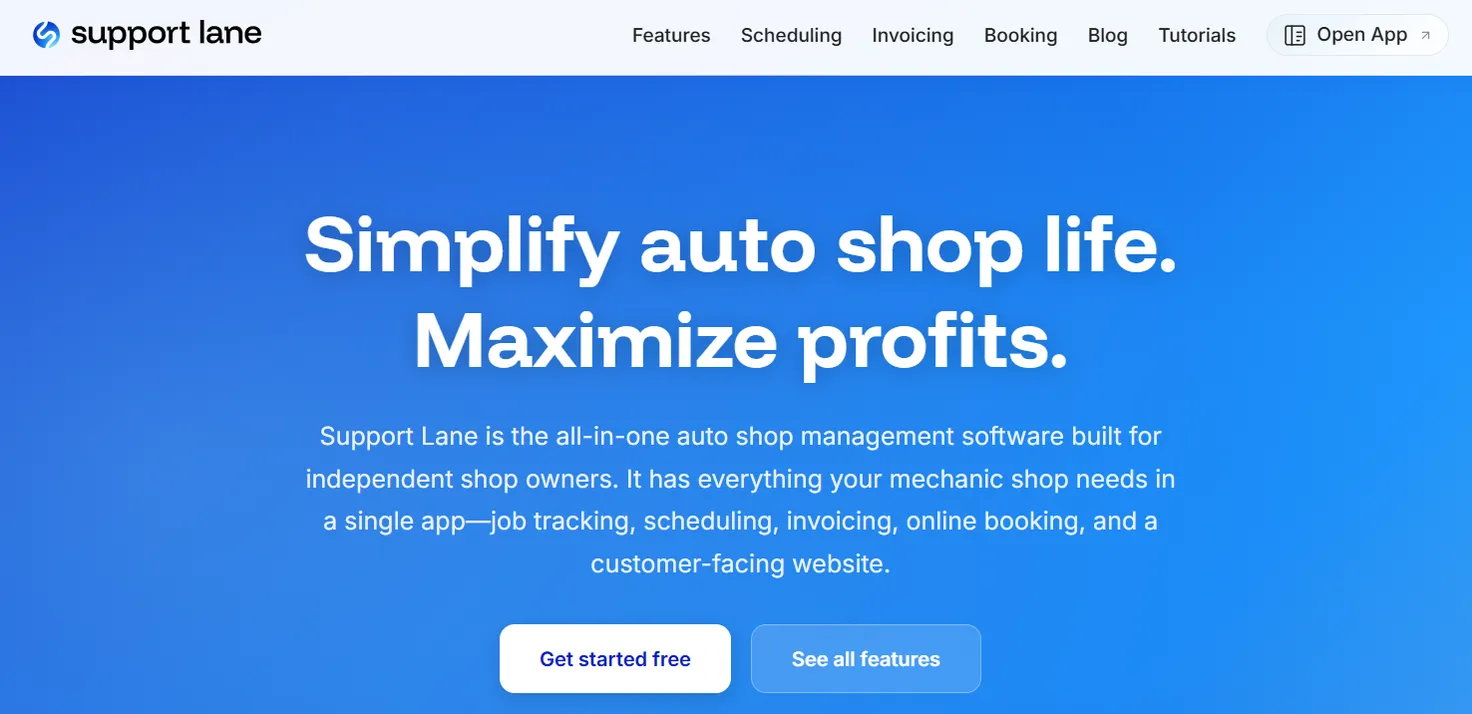
Support Lane changes how business plans are created. Instead of a messy guessing game with disconnected spreadsheets and unclear estimates, shop owners can pull real information directly from the system that runs their daily operations. Your business plan becomes a living reflection of how your shop functions.
🎯 Key Point: Transform your business planning from guesswork into data-driven decision-making with real-time operational insights.
"Business plans built on actual operational data are 3x more accurate than traditional estimates and projections." — Small Business Administration, 2023
💡 Tip: Use Support Lane's integrated data to create financial projections that reflect your shop's true performance patterns and customer behavior.
Centralized Data Eliminates Market Research Guesswork
Most independent shops struggle to answer basic market questions because customer information is scattered across paper invoices, notebooks, and email threads. Our Shop management software consolidates customer profiles, vehicle details with VIN decoding, and service histories into one searchable database. Your business plan's market section can now reflect what customers actually buy rather than estimates. You can confidently state that 62% of your customers drive vehicles over seven years old, or that transmission services generate 23% of monthly revenue, because the system tracks it automatically.
Service Templates Create Pricing Transparency
The pricing strategy section falls apart without accurate cost structures. Support Lane's reusable service templates to lock in labor times, parts costs, sublet fees, and markups for every common job, creating a pricing library that feeds directly into financial forecasts. This precision matters when lenders assess whether your $18,000 monthly revenue target aligns with your actual service capacity and pricing model.
Visual Workflows Prove Operational Readiness
Lenders reject business plans that describe operations in vague terms because such vagueness signals execution risk. Support Lane's Kanban board view with customizable pipelines, color-coded job stages, and time tracking demonstrates exactly how vehicles move from intake through diagnosis, approval, repair, and delivery. Document this workflow in your operations section with screenshots and stage-specific metrics, demonstrating a repeatable system to lenders rather than improvised chaos. When a plan states "average job completion time: 2.3 days," backed by pipeline data, it carries more weight than "we work efficiently" ever will.
Integrated Financial Tools Replace Projection Guesswork
Financial projections fail when they rely on optimistic estimates rather than actual transaction patterns. Support Lane captures every estimate, invoice, payment, refund, and tax calculation, building a revenue and expense history that informs realistic forecasts. Your cash flow projections can reference actual payment timing (68% of customers pay within 24 hours, 22% within a week), average invoice values by service category, and seasonal revenue fluctuations, giving lenders confidence that your numbers reflect operational reality rather than optimistic assumptions.
Sign up for Your Free Trial to Manage your Auto Shop with Ease Today
Your business plan maps out your strategy, but execution happens in your systems. The gap between planning and making money widens when daily operations run on paperwork, scattered spreadsheets, and memory instead of structure. Every hour spent hunting for customer records or manually tracking job status detracts from the growth your plan promised.
🎯 Key Point: The difference between successful shops and struggling ones isn't the quality of their business plan—it's the execution of daily operations through organized systems.
Shop management software like Support Lane transforms your operational blueprint into a working infrastructure. Our Kanban board tracks every job from estimate to completion. Integrated invoicing pulls data from completed jobs, enabling financial tracking that makes your projections measurable. Online booking automates customer acquisition, while calendar features handle scheduling you know you need but haven't built yet.
"Without unified systems, 83% of small businesses struggle to scale beyond their initial growth phase due to operational inefficiencies." — Small Business Operations Report, 2024
Without unified systems, your plan gathers dust while competitors with operational infrastructure serve customers faster, communicate professionally, and grow without chaos.
Features, Benefits & Impact
Kanban board
Benefit: Visual job tracking
Impact: Real-time project status visibility
Integrated invoicing
Benefit: Automated billing
Impact: Faster payment cycles and improved cash flow
Online booking
Benefit: Customer self-service
Impact: 24/7 lead capture without manual intervention
Calendar management
Benefit: Organized scheduling
Impact: Eliminates double-bookings and scheduling conflicts
Support Lane offers a free trial with no credit card required. Sign up, import your existing data, and watch workflows organize within minutes. You get full access to scheduling, invoicing, customer management, and job tracking immediately.
💡 Tip: Most shop owners see immediate improvements in daily efficiency within the first week of implementing organized digital workflows.
Ready to move from planning to execution? Start your free trial at https://supportlane.io/ and build the shop your business plan describes.
Related Reading
Ready to modernize your shop?
Join the independent auto repair shops already using Support Lane to manage their jobs, customers, and invoices in one place.